1. Understand What the Report Is—and Isn't
Under Oregon’s home inspector standards of practice, a report is based solely on conditions observed at the time of inspection. It is visual and not technically exhaustive. Inspectors are not required to report the life expectancy of any component or system, or the methods, materials, and costs of corrections (OAR 812-008-0202 through 0204).² A silent report is not a clean bill of health. Treat inaccessible areas and any “further evaluation recommended” note as open questions, not resolved items.
2. Verify the Inspector's Credentials
An individual may not undertake, offer, or bid home inspector work unless certified as a home inspector by the Construction Contractors Board (CCB) and an owner of, or employed by, a CCB-licensed business. This requirement appears in ORS 701.445, renumbered from ORS 701.350 in 2015.³ Use the state license directory to make a two-part check: confirm both the individual’s certification and the business’s CCB license.⁴
3. Respect Confidentiality and Contract Terms
Oregon home inspectors may not disclose information about inspection results without the approval of the client for whom the inspection was undertaken.² Contract restrictions on sharing the document do not remove your duty to disclose known material facts.
OREF’s 2026 guidance, “Inspection Reports and Repair Bids: Know the Difference,” explains that sending the report to the seller without a written request breaches the agreement provision. The breach does not automatically void the inspection contingency. OREF also notes that repair bids are not inspection reports. OREF labels this guidance a nonlegal opinion, so refer disputes to an attorney.⁶
As a recommended practice, get your client’s written authorization before sharing the report, bids, or excerpts. Authorization does not override contractual delivery restrictions, so check both.
4. Disclose Material Facts and Recommend Experts
A seller’s agent must disclose material facts known by the agent that are not apparent or readily ascertainable to a party (ORS 696.805(5)(c)). A buyer’s agent has the same duty (ORS 696.810(5)(c)).¹ Communicate findings promptly to your client.
A seller’s agent must advise the seller, and a buyer’s agent must advise the buyer, to seek expert advice on matters related to the transaction that are beyond the agent’s expertise. Those sections do not imply a duty to investigate matters outside a licensee’s expertise, such as the condition of property, unless the licensee or the licensee’s agent agrees in writing to investigate.¹
If a report notes a foundation crack, don’t tell your client, “That’s normal.” Recommend a structural engineer and document the recommendation.
A licensee must not discourage any party to a real estate transaction from seeking an attorney’s advice about a matter involving real estate activity in which the licensee is involved (OAR 863-015-0155).⁵ Escalate legal questions to your principal broker.
5. Track Contingency Deadlines
An inspection contingency is a contract term that lets the buyer act on inspection results within the agreed period. Take deadlines from the executed agreement and any applicable addenda, such as the OREF 001 sale agreement and the OREF 022A Buyer's Repair Addendum.⁶ No single standard period applies, so read the documents. Put any extension in writing and get it signed before the deadline passes.
The seller disclosure process runs on a separate track. A buyer’s statutory right to revoke the offer after receiving the seller’s disclosure statement arises under ORS 105.462–105.490, independent of the inspection contingency.⁷ Verify the current revocation window rather than quoting it from memory.
6. Keep Complete Records
OREA guidance lists inspection reports, repair estimates, and clearances—documents confirming that a repair or condition was resolved—among the items to keep in the transaction file.⁸ Maintain these records under OAR 863-015-0250 and 863-015-0260.⁵ Documentation is also sound risk management.⁹
Broker's Checklist
- Confirm the inspector’s individual certification and the business’s CCB license.
- Note inaccessible areas, visual limitations, and “further evaluation” items.
- Communicate findings promptly to your client.
- Recommend qualified experts in writing.
- Never discourage a party from consulting an attorney.
- Check contract delivery terms and get written client authorization before sharing the report, bids, or excerpts.
- Calendar deadlines from the executed agreement and addenda; extend in writing before they lapse.
- Track the seller disclosure revocation right separately.
- File reports, estimates, clearances, and communications.
- Evaluate known material facts for disclosure.
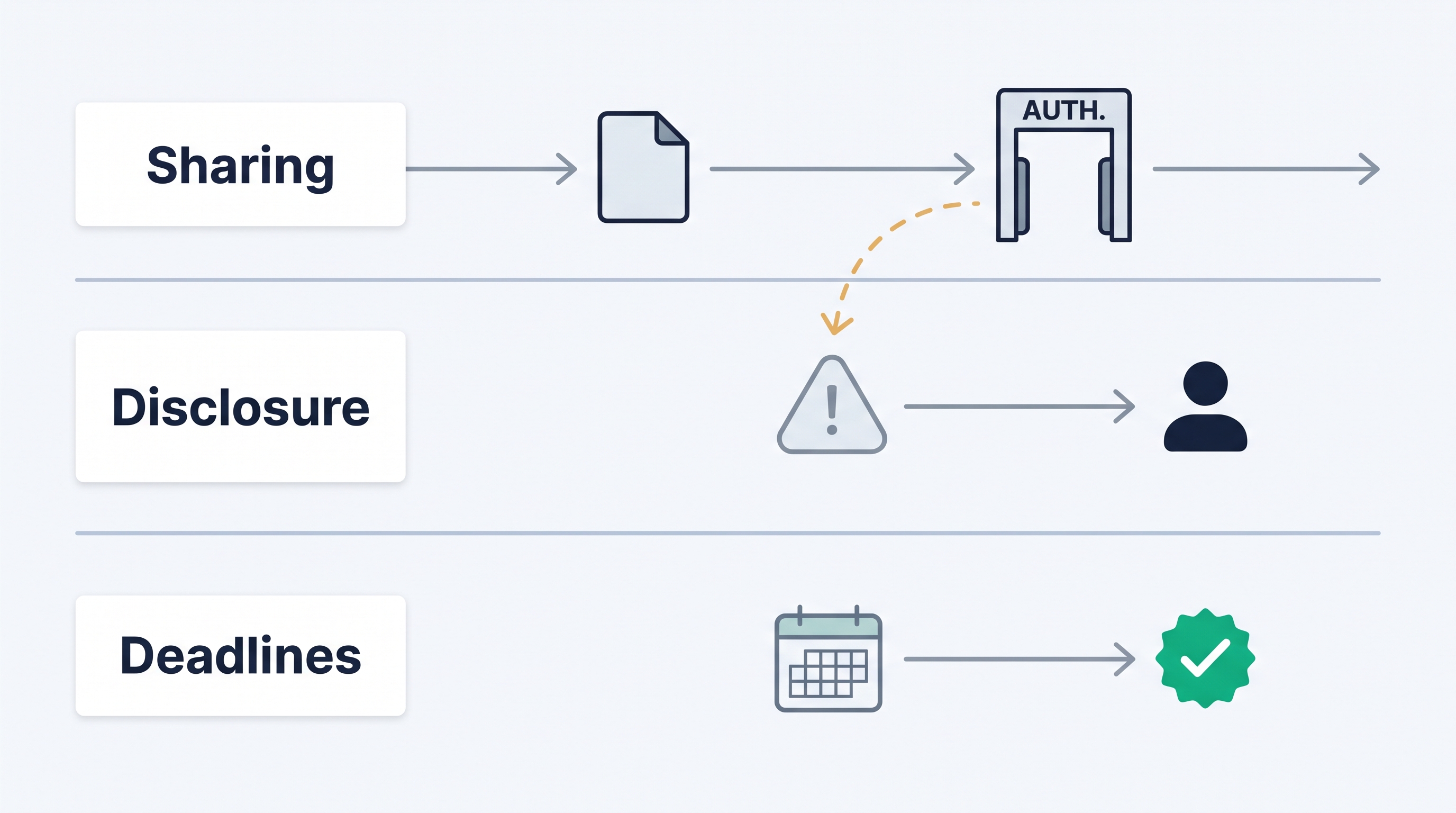
Three tracks brokers manage after receiving an inspection report: sharing (with authorization), disclosure (of material facts), and deadlines (from the executed agreement).
Scenario: Crawlspace Moisture
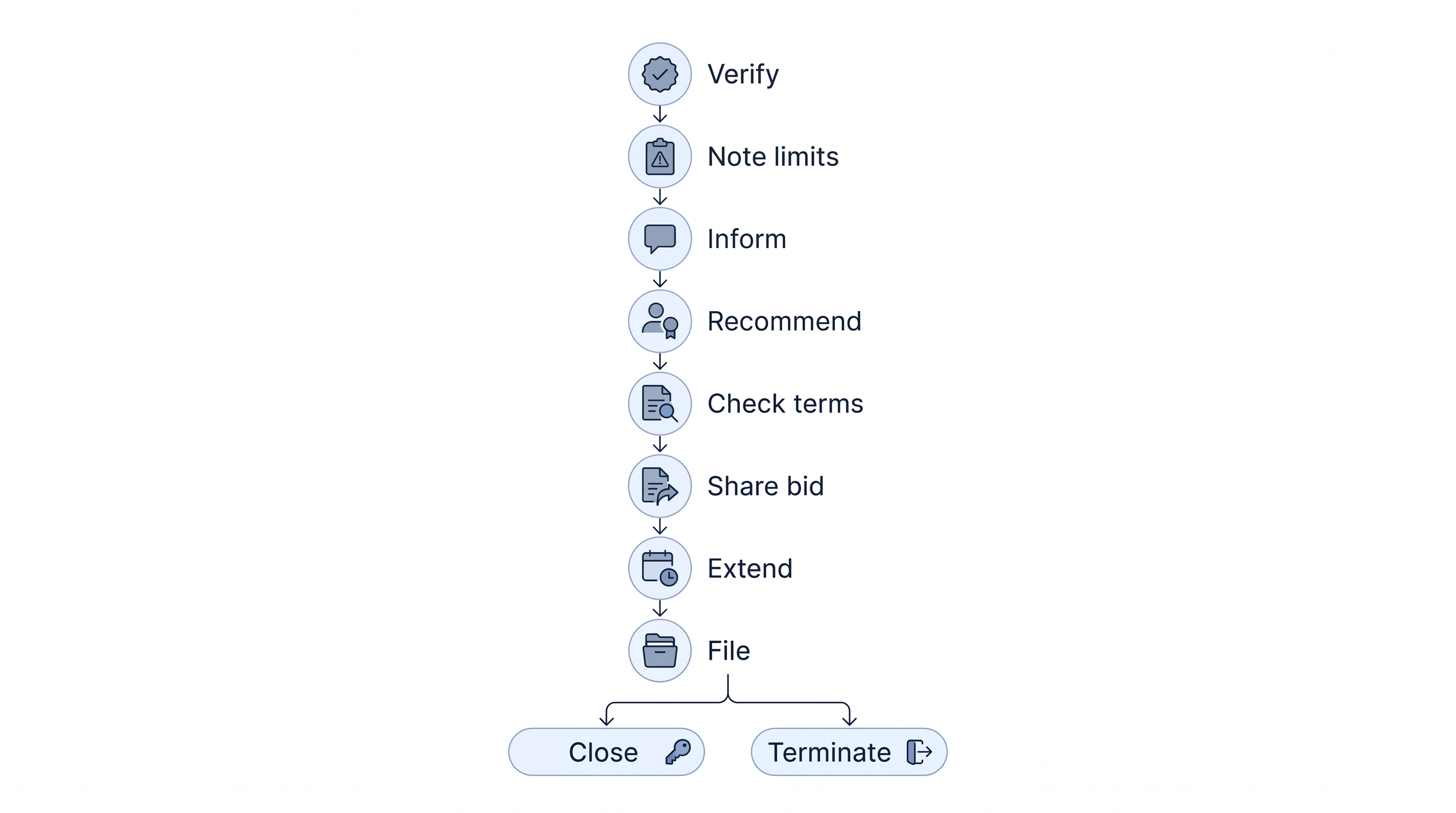
Step-by-step broker workflow illustrated by the crawlspace moisture scenario.
An inspector reports moisture and staining in the crawlspace and notes that part of it was inaccessible. The buyer’s broker first checks the inspector’s certification and the business’s CCB license. The broker then notes the report’s visual limitation, promptly informs the client, and recommends a moisture specialist.
The specialist provides a bid. After checking the agreement’s delivery terms, the buyer’s broker shares only the specialist’s bid and the repair request authorized in writing by the buyer. Because the specialist needs more time, the parties sign an extension of the inspection deadline set in the executed agreement and any applicable addenda. The broker files everything.
The buyer ultimately terminates. The listing broker now knows of a possible material fact and must evaluate it for disclosure to future buyers, regardless of whether the full report was shared.
Master Oregon inspection report handling: verify CCB credentials, protect disclosures, and track deadlines. Call 425-775-2313 for guidance.